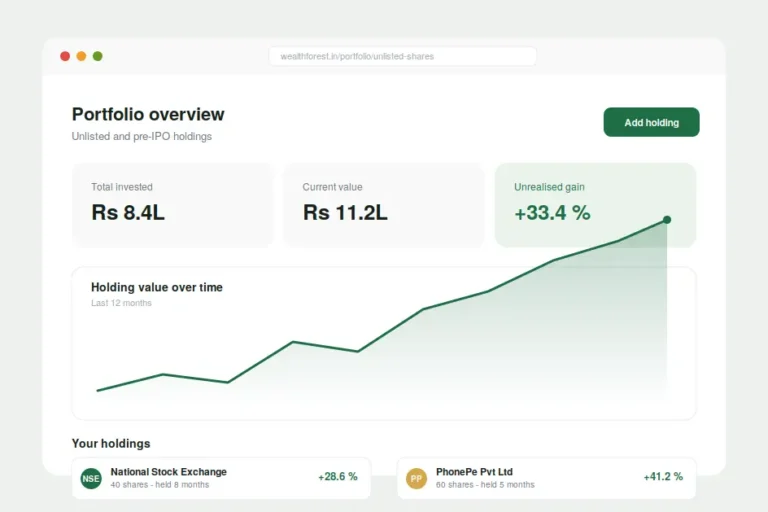
A few years ago, unlisted shares in India were a quiet, insider game reserved for promoters, employees with ESOPs, and a handful of well-connected family offices. That’s changed.
Today, a growing number of Indian investors are actively buying stakes in companies like the National Stock Exchange (NSE), Chennai Super Kings (CSK), and other well-known private businesses long before these companies ever ring a listing bell on the NSE or BSE.
Why the sudden interest? Because early investors in some of India’s biggest IPOs have seen outsized gains, and word has spread. But unlisted shares are not “listed shares with better returns.” They come with different rules, different tax treatment, and different risks, and getting any one of these wrong can be expensive.
This guide breaks down exactly what unlisted shares are, why experienced investors are adding them to their portfolios, how the buying process actually works, and what you must check before you commit your first rupee.
Unlisted shares are equity shares of a company that has not yet completed its Initial Public Offering (IPO) and is therefore not traded on a recognised stock exchange like the NSE or BSE.
These shares typically belong to one of three categories:
Since there’s no exchange order book, unlisted shares trade over-the-counter (OTC). A buyer and seller, usually connected through a specialised platform or broker, agree on a price, and the shares are transferred directly through your demat account via NSDL or CDSL.
Three forces are driving this trend simultaneously.
1. Access has become far easier. A few years ago, buying pre-IPO stock required personal connections to promoters or employees. Now, dedicated platforms aggregate sellers, verify KYC, and route the transfer through your demat account making the process almost as simple as a regular stock purchase.
2. India’s IPO pipeline is unusually strong. With a steady flow of large, well-funded private companies expected to list over the next few years, investors want in before the valuation gets set by public market demand rather than private negotiation.
3. Past listings have created visible wealth stories. When a company that traded privately for years finally lists often at a premium to its last unlisted price. It reinforces the idea that getting in early can pay off. Naturally, this fuels demand, but it also means prices in the unlisted market can run ahead of fundamentals.
None of this means unlisted shares are a shortcut to guaranteed profit. It means more people now have access to an asset class that previously sat outside their reach, and access alone doesn’t remove the risk.
Unlike listed stocks, you can’t buy unlisted shares through your regular trading app. Here’s the actual process:
| Parameter | Unlisted Shares | Listed Shares |
|---|---|---|
| Where they trade | Over-the-counter (private deals) | Stock exchange (NSE/BSE) |
| Price discovery | Negotiated, based on demand and last deal price | Live market price |
| Liquidity | Low — no guaranteed buyer when you want to sell | High — can usually sell instantly |
| Minimum investment | Often ₹10,000–₹2,00,000+ depending on the stock | As low as the price of one share |
| LTCG holding period | More than 24 months | More than 12 months |
| LTCG tax rate | 12.5%, no indexation | 12.5% (above ₹1.25 lakh exemption) |
| STCG tax rate | Investor’s income tax slab rate | Flat rate under Section 111A |
| Regulatory oversight | Limited — no exchange safety net | High — SEBI-regulated exchange trading |
Tax treatment is where many first-time investors get caught off guard, so it deserves its own section.
Holding period matters more than with listed stocks. For unlisted shares, gains are treated as long-term only if you’ve held them for more than 24 months — double the 12-month threshold that applies to listed equity.
Short-term gains (24 months or less) are added to your total income and taxed at your applicable income tax slab rate, which can go up to 30% plus surcharge and cess for high earners.
Long-term gains (over 24 months) are currently taxed at a flat 12.5%, without the benefit of indexation, following the changes introduced in the Union Budget 2024.
No Securities Transaction Tax (STT) applies to unlisted share transactions, since STT is only levied on recognised exchange trades, unlike listed shares.
ESOP holders face a slightly different structure: the gap between fair market value and exercise price at the time of exercise is taxed as a perquisite (salary income), and only the subsequent gain on sale is taxed as capital gains.
Given how easily these calculations can go wrong, it’s worth having a qualified advisor review your specific transaction before filing your return. The FMV computation for unlisted shares isn’t always straightforward.
Unlisted shares can genuinely diversify a portfolio, but they are not a “safer version” of pre-IPO investing. Be clear-eyed about these risks:
The safeguard against all five is the same: work only with verified, reputable platforms or advisors, and never invest more than you’re prepared to hold for several years without an easy exit.
Unlisted shares tend to suit investors who:
They’re generally not suitable for investors who need liquidity in the near term, are investing on tips or hearsay, or don’t yet have a solid foundation of core investments in place.
1. Are unlisted shares legal to buy in India? Yes. Buying unlisted shares is completely legal, provided KYC norms are followed and the shares are transferred to your demat account through NSDL or CDSL.
2. How much money do I need to start investing in unlisted shares? It varies widely by company and platform, but many unlisted shares are available starting from roughly ₹10,000, while well-known names can require significantly higher minimum investments.
3. Can I sell unlisted shares whenever I want? Not always. Since there’s no exchange, you depend on finding a willing buyer, which can take time, This is the core liquidity risk of the asset class.
4. Do unlisted shares eventually have to list on the stock exchange? No. Some companies list within a few years, others take much longer, and some may never go public at all. Never invest based on an assumed listing timeline.
5. What happens to my unlisted shares after the company’s IPO? Once the company lists, your shares typically convert to regular listed equity in your demat account, though pre-IPO investors often face a lock-in period post-listing.
6. Is the tax on unlisted shares higher than on listed shares? It depends on your holding period and income slab. Long-term unlisted share gains are taxed at 12.5% (no indexation), while short-term gains are taxed at your income slab rate, which can be higher than the flat rate applied to short-term listed equity gains.
7. How do I know if an unlisted share’s price is fair? Ask for the company’s recent financials, valuation history, and comparable listed peers. If a platform can’t provide this, treat that as a red flag rather than proceeding on price alone.
8. Should beginners invest in unlisted shares? It’s generally better suited to investors who already have a diversified core portfolio. If you’re just starting out, prioritise mutual funds and equities first, and consider unlisted shares only as a smaller, later addition.
Unlisted shares have opened up a genuinely interesting opportunity for Indian investors. A chance to hold a stake in companies before the broader market ever gets the chance to buy in. But “early access” is not the same as “easy money.” The illiquidity, tax treatment, and lack of exchange-level protection mean this asset class rewards patience and research far more than urgency.
If you already have a well-diversified portfolio and are exploring unlisted shares as your next step, the smartest move is to treat it exactly like any other serious investment decision, with due diligence, not just enthusiasm.
Thinking about adding unlisted shares to your portfolio? WealthForest’s advisory team can help you evaluate opportunities, verify company fundamentals, and understand the tax impact before you invest. Get in touch with our unlisted shares desk to start with a free portfolio consultation.

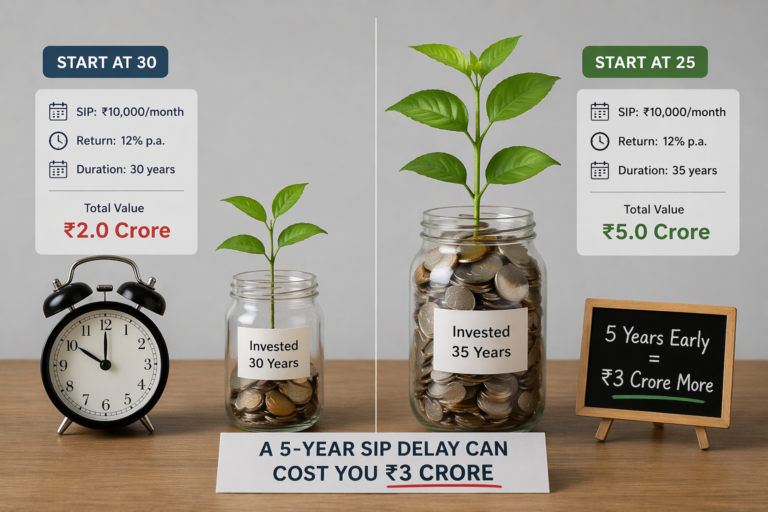
A 5-year SIP delay can cost ₹3 crore. Learn why early investing matters and start your SIP today for long-term wealth.
Many investors underestimate how costly delaying investments can be.
The truth is, SIP delay cost ₹3 crore in India is not just a headline, but a real financial impact caused by lost compounding time.
Even a small delay of 5 years can significantly reduce your final wealth.
This happens because the earlier you start, the more time your money gets to grow.
In this blog, you will understand why starting your SIP early is crucial and how delaying it can cost you crores in the long run.
A Systematic Investment Plan (SIP) lets you invest small amounts regularly.
It helps you build wealth slowly and consistently.
Key benefits:
👉 Start at age 25 → ₹3.5 crore
👉 Start at age 30 → ₹2 crore
Difference: ₹1.5 crore+ lost
Increase SIP or time horizon → Loss can touch ₹3 crore.
Compounding works like a snowball.
It grows slowly first.
Then it explodes.
When you delay, you lose the fastest growth years.
Your first investments matter the most.
They stay invested the longest.
Even small amounts grow huge over time.
Delay means fewer total investments.
Example:
That’s 60 fewer investments.
Markets move in cycles.
Delaying means you may miss:
To catch up, you must invest more.
Example:
That creates financial pressure.
Money loses value over time.
₹1 crore today won’t be enough later.
Delaying SIP makes inflation hit harder.
Late investors panic more.
They:
Let’s break it down clearly:
👉 Final Value: ₹3.5 crore
👉 Final Value: ₹2 crore
Time in the market beats timing the market.
Even a small delay creates a massive gap.
Don’t wait for:
Start with what you have.
Use step-up strategy:
Markets will fluctuate.
But consistency wins.
Think 15–30 years.
Short-term thinking kills returns.
Focus on:
Wrong.
Starting small is better than waiting.
Markets always seem high.
Long-term investing reduces risk.
No.
Best time was yesterday.
Second best is today.
A 5-year delay may feel small.
But financially, it can cost you crores.
Wealth is not built by timing.
It is built by time + discipline.
The earlier you start, the easier your journey becomes.
Ask yourself one question:
Will you delay or start today?
Because every year you wait,
your future wealth keeps shrinking.
Delaying your SIP can cost you crores.
But starting the right way can secure your financial future.

Copyright © 2025 wealthforest.
All Rights Reserved, Built with ♥ in India
AMFI Registered mutual fund distributor





Unit- 205, D-85, Sec 63, Noida, UP 201301

WEALTHFOREST FINSERVE PVT. LTD. (CIN: U67110RJ2022PTC084346) IS A REGISTERED MEMBER OF THE NSE & BSE -59819 AND A MUTUAL FUND DISTRIBUTOR WITH AMFI REGISTRATION NO: ARN-276231. * REGISTERED OFFICE: 3/196, SEC 3, JAWAHAR NAGAR, JAIPUR, RAJASTHAN - 302004. GST - 08AADCW3948H1Z0
*CORPORATE OFFICE: UNIT-205, D-85, SECTOR 63, NOIDA, INDIA – 201301.
FOR ANY GRIEVANCES, PLEASE CONTACT US AT: SUPPORT@WEALTHFOREST.IN
THE INFORMATION PROVIDED ON OUR BLOG IS FOR EDUCATIONAL PURPOSES ONLY AND SHOULD NOT BE CONSTRUED AS INVESTMENT OR TAX ADVICE. MUTUAL FUND INVESTMENTS ARE SUBJECT TO MARKET RISKS. PLEASE READ ALL SCHEME-RELATED DOCUMENTS CAREFULLY BEFORE INVESTING. PAST PERFORMANCE IS NOT INDICATIVE OF, NOR DOES IT GUARANTEE, FUTURE PERFORMANCE. THE TERMS AND CONDITIONS OF THE WEBSITE/APP APPLY. PLEASE REFER TO OUR PRIVACY POLICY FOR FURTHER DETAILS.
POPULAR MUTUAL FUNDS:
QUANT SMALL CAP FUND | ICICI PRUDENTIAL BLUECHIP FUND | NIPPON INDIA SMALL CAP FUND | PARAG PARIKH FLEXI CAP FUND | MOTILAL OSWAL MIDCAP FUND | SBI SMALL MIDCAP FUND | TATA DIGITAL INDIA FUND | AXIS MULTICAP FUND | ICICI PRUDENTIAL TECHNOLOGY FUND | HDFC FLEXI FUND | HDFC SMALL CAP FUND | AXIS EQUITY FUND | CANARA ROBECO SMALL CAP FUND | TATA SMALL CAP FUND | KOTAK EMERGING FUND
MUTUAL FUNDS PARTNERS:
SBI | AXIS | HDFC | UTI | NIPPON INDIA | ICICI PRUDENTIAL | TATA | KOTAK | DSP | CANARA ROBECO | SUNDARAM | MIRAE ASSET | BANDHAN | FRANKLIN TEMPLETON | PPFAS | MOTILAL OSWAL | INVESCO | EDELWEISS | ADITYA BIRLA SUN LIFE | LIC | HSBC | NAVI | QUANTUM | UNION | MAHINDRA MANULIFE | 360 ONE | BOI | JM FINANCIAL | PGIM | QUANT |