

LOGIN / SIGN UP
Wealthforest
Blogs

Ultimate Financial Planning for Salaried Pros, Business Owners, NRIs

Two people can earn the same ₹30 Lakh a year and need completely different Financial planing strategies. One has a monthly salary, EPF and an employer health cover. Another has a business whose income swings between quarters and whose biggest asset is the business itself. A third lives in Dubai, earns in Dirhams, and has parents, property and investments back in India.

Financial planning for salaried professionals, business owners and NRIs follows the same basic steps: protect, save, invest and plan for retirement. What changes is how much liquidity you need, which risks matter most, how you are taxed, and which rules apply to your money. This guide covers each group and ends with a comparison table you can use as a checklist.

In this guide

  • Why the three plans differ
  • Financial planning for salaried professionals
  • Financial planning for business owners
  • Financial planning for NRIs
  • Comparison table
  • Common mistakes
  • How to start in five steps
  • FAQs

This article is educational and not personalized financial or tax advice. Tax rules change often. Confirm current figures with the Income Tax Department or a qualified professional before acting.

Why one financial plan doesn’t fit everyone

A plan depends on four things: how stable your income is, who depends on it, how your income is taxed, and which regulations govern your money. A salaried employee mostly has stable income and automatic savings through payroll. A business owner has variable income and mixes personal and business risk. An NRI has to deal with cross-border tax and foreign exchange rules on top of everything else.

Financial planning for salaried professionals

What makes the salaried situation different

Your income is predictable and your tax is deducted at source, which makes planning easier. The risk is that things feel handled when they aren’t. Employer cover usually ends when the job does, and EPF alone rarely funds a full retirement.

1. Choose your tax regime deliberately

The Income-tax Act, 2025 came into force on 1 April 2026 and replaces the 1961 law. Budget 2026-27 made no change to income tax slabs. The ₹75,000 standard deduction for salaried people under the new regime also continues for Tax Year 2026-27. The new regime is the default regime.

The practical rule is to calculate both regimes each year rather than assuming one wins. The old regime can still come out ahead if you have significant deductions such as home loan interest, HRA and eligible investments. Use the official Income Tax Department calculator for your numbers.

2. Build an emergency fund first

A common guideline is 6 months of essential expenses in a liquid, low-risk place such as a savings account, liquid fund or short-term deposit. People with a single income earner in the family or an uncertain industry often hold more. This is a rule of thumb, not a regulation.

3. Fix insurance before investing aggressively

  • Term life insurance: needed if anyone depends on your income. A frequently quoted range is 10 to 15 times annual income, but the right number depends on loans, dependents and existing assets.
  • Health insurance: buy a personal policy even if your employer provides one. Group cover can disappear when you change jobs or retire.

4. Use retirement tools you already have

  • EPF and VPF: a steady, low-risk base.
  • NPS: an employer contribution to NPS has been allowed as a deduction under the new regime as well. Check the current limit with your payroll or tax professional.
  • SIPs in diversified equity and index funds: for long-term growth that EPF alone won’t deliver.

5. Handle ESOPs and bonuses carefully

Employee stock options are taxed at exercise as a perquisite and again at sale as capital gains. Plan the cash for the first tax bill before you exercise.

Financial planning for business owners

What makes this situation different

Your income is irregular, your wealth is concentrated in one business, and the business and your family finances are often tangled together. Most business-owner plans fail for one reason: personal and business money share an account.

1. Separate business and personal finances

Pay yourself a defined salary or drawing from the business account into a personal account. This makes your personal budget realistic, simplifies tax filing, and makes it easier to get loans and insurance.

2. Keep a larger emergency reserve

Business income can fall suddenly. Many planners suggest 9 to 12 months of personal expenses plus a separate working-capital buffer for the business. Keep the two reserves separate.

3. Understand your tax structure

Tax depends on whether you operate as a proprietor, partnership, LLP or company. Small businesses and professionals may qualify for presumptive taxation under Sections 44AD and 44ADA, which have turnover limits that have been revised over time. A chartered accountant should confirm your eligibility. A company can also choose between salary and dividend, and the tax effect of each should be compared.

4. Cover business-linked risks

  • Term insurance large enough to cover business loans you have personally guaranteed.
  • Health insurance for you and your family, since there is no employer cover.
  • Key-person and business continuity planning if the business depends on you or a partner.

5. Don’t make the business your entire retirement plan

Many owners assume they will sell the business to fund retirement. That depends on a buyer and a valuation you can’t guarantee. Build an independent corpus through NPS, mutual funds and other diversified assets, so retirement doesn’t depend on a sale.

6. Plan succession early

A will, nominee details and a clear plan for who runs the business protect the family and the company.

Financial planning for NRIs

What makes this situation different

NRIs deal with two countries’ rules. The main concerns are residential status, the right bank accounts, which investments are permitted, how Indian income is taxed, and how money moves back abroad.

1. Confirm your residential status each year

Under Indian tax law, your status as resident or non-resident is determined by days spent in India in the year and preceding years. Rules differ for Indian citizens who leave India for employment and for those who visit. Status can change, and it affects how your global income is taxed, so verify it every year.

2. Use the right bank account

AccountHoldsInterest tax in IndiaRepatriation
NREForeign earningsGenerally tax-free while you remain a non-residentFreely repatriable
NROIndian income (rent, dividends, etc.)Taxable, with TDSLimited per year, subject to conditions
FCNRForeign currency depositsGenerally tax-free for non-residentsRepatriable

Check current RBI and bank rules before opening or converting accounts, as limits and conditions can change.

3. Know where you can and can’t invest

NRIs can invest in Indian mutual funds, listed equities (through an authorized route such as a PIS account), NPS and certain deposits. Some restrictions apply: agricultural land, plantation property and farmhouses cannot be bought by NRIs, and some fund houses restrict investors from particular countries. Confirm availability with the platform before planning around a product.

4. Understand Indian taxes on your income

  • Indian-source income such as rent, interest, dividends and capital gains is taxable in India.
  • TDS on NRI income is often higher than for residents, especially on property sales and NRO interest.
  • A Double Taxation Avoidance Agreement (DTAA) between India and your country of residence may allow you to claim credit or relief, so you are not taxed twice on the same income.

5. Plan repatriation and currency risk

Your goals may be in rupees (a home or family support in India) or in your country of residence. Decide which, because currency movements can change returns significantly when converted back.

6. Don’t forget the Indian side of family planning

NRIs often have parents in India, jointly held property and nominations that are outdated. A power of attorney, a valid will and updated nominees avoid long delays later.

Comparison: Salaried vs Business Owner vs NRI

AreaSalariedBusiness ownerNRI
IncomeStable, monthlyVariableOften foreign currency
Emergency fund~6 months~9 to 12 months plus business bufferDepends on where expenses fall
Tax handlingTDS, regime choiceStructure-based, advance taxResidential status, TDS, DTAA
Insurance gapLosing employer coverNo employer cover, business debtCover in India vs abroad
Retirement toolsEPF, VPF, NPS, SIPsNPS, mutual funds, non-business assetsNPS, mutual funds, deposits
Biggest riskUnder-savingConcentration in one businessCompliance and currency
First actionCompare tax regimesSeparate financesConfirm residential status

Common mistakes by group

Salaried: relying only on employer insurance, ignoring the EPF-only retirement shortfall, and never reviewing the tax regime.

Business owners: mixing accounts, having no personal emergency fund, and treating the business as the retirement plan.

NRIs: keeping money in the wrong account type, missing Indian tax filings, and not updating nominees and wills.

How to start in five steps

  1. Write down income, expenses and dependents to understand your cash flow.
  2. Build the emergency fund appropriate to your group.
  3. Close the insurance gap with term and health cover.
  4. Set goals with dates and amounts: retirement, children’s education, a home.
  5. Invest through suitable products and review once a year or after major life changes.

Frequently Asked Questions

What is the difference between financial planning for salaried people and business owners?

Salaried people have stable income and automatic savings, so planning focuses on tax choices, insurance, and retirement. Business owners have variable income and concentrated risk, so planning focuses on separating finances, maintaining larger reserves, and non-business retirement assets.

What financial planning does an NRI need in India?

An NRI needs to confirm residential status, use NRE, NRO and FCNR accounts correctly, understand Indian tax and TDS, check DTAA relief, and plan repatriation of funds.

Is the new tax regime better for salaried employees?

It depends on your deductions. The new regime is the default, but the old regime can be better if you claim substantial deductions. Calculate both every year.

How big should a business owner’s emergency fund be?

Many planners suggest 9 to 12 months of personal expenses, plus a separate working-capital reserve for the business.

Can NRIs invest in mutual funds in India?

Yes, generally, subject to KYC and FATCA compliance. Some fund houses limit investors from certain countries, so check with the fund house.

Does an NRI pay tax in India and abroad on the same income?

Possibly, but a DTAA between India and the other country may provide credit or relief to avoid double taxation. Seek professional advice for your situation.

How often should I review my financial plan?

At least once a year, and after major events such as a job change, business expansion, marriage, a child’s birth, or a move abroad.

Conclusion

The three groups share the same goals but face different risks. Salaried professionals should avoid complacency about employer benefits. Business owners should keep the business and family finances apart and build wealth outside the company. NRIs should get the account structure, tax status and repatriation rules right first.

If you’d like a plan matched to your situation, speak to a Wealth Forest advisor for a personalized review.

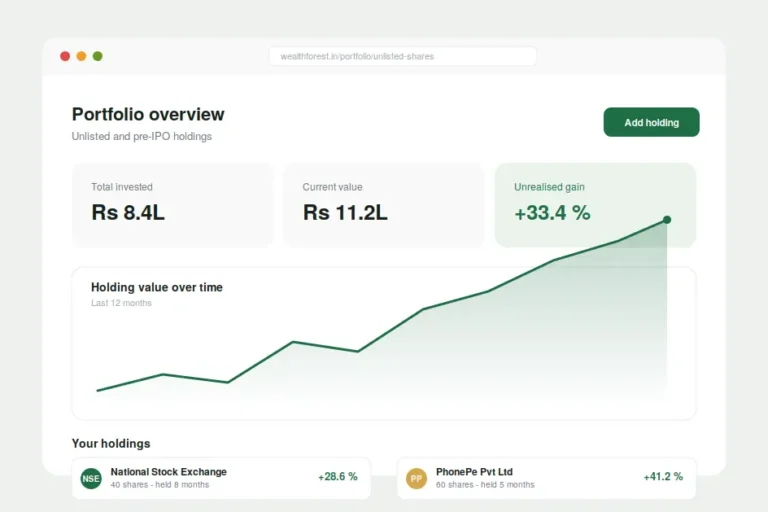
Unlisted shares portfolio dashboard showing investment value, portfolio growth, unrealised gains, and pre-IPO stock holdings over time.
Blogs

Unlisted Shares Investment Guide: Everything You Need to Know

A few years ago, unlisted shares in India were a quiet, insider game reserved for promoters, employees with ESOPs, and a handful of well-connected family offices. That’s changed.

Today, a growing number of Indian investors are actively buying stakes in companies like the National Stock Exchange (NSE), Chennai Super Kings (CSK), and other well-known private businesses long before these companies ever ring a listing bell on the NSE or BSE.

Why the sudden interest? Because early investors in some of India’s biggest IPOs have seen outsized gains, and word has spread. But unlisted shares are not “listed shares with better returns.” They come with different rules, different tax treatment, and different risks, and getting any one of these wrong can be expensive.

This guide breaks down exactly what unlisted shares are, why experienced investors are adding them to their portfolios, how the buying process actually works, and what you must check before you commit your first rupee.

Table of Contents

  1. What Are Unlisted Shares?
  2. Why Are Investors Buying Unlisted Shares Right Now?
  3. How to Buy Unlisted Shares in India (Step by Step)
  4. Unlisted Shares vs Listed Shares: A Quick Comparison
  5. Taxation on Unlisted Shares in India
  6. Risks You Cannot Afford to Ignore
  7. Who Should (and Shouldn’t) Invest in Unlisted Shares
  8. Key Takeaways
  9. Frequently Asked Questions
  10. Conclusion

What Are Unlisted Shares?

Unlisted shares are equity shares of a company that has not yet completed its Initial Public Offering (IPO) and is therefore not traded on a recognised stock exchange like the NSE or BSE.

These shares typically belong to one of three categories:

  • Pre-IPO companies that have filed or are expected to file for an IPO in the near future
  • Large private businesses that may never list, but still change hands privately (NSE being a well-known example)
  • ESOP shares sold by employees of startups and private companies before a listing event

Since there’s no exchange order book, unlisted shares trade over-the-counter (OTC). A buyer and seller, usually connected through a specialised platform or broker, agree on a price, and the shares are transferred directly through your demat account via NSDL or CDSL.

Why Are Investors Buying Unlisted Shares Right Now?

Three forces are driving this trend simultaneously.

1. Access has become far easier. A few years ago, buying pre-IPO stock required personal connections to promoters or employees. Now, dedicated platforms aggregate sellers, verify KYC, and route the transfer through your demat account making the process almost as simple as a regular stock purchase.

2. India’s IPO pipeline is unusually strong. With a steady flow of large, well-funded private companies expected to list over the next few years, investors want in before the valuation gets set by public market demand rather than private negotiation.

3. Past listings have created visible wealth stories. When a company that traded privately for years finally lists often at a premium to its last unlisted price. It reinforces the idea that getting in early can pay off. Naturally, this fuels demand, but it also means prices in the unlisted market can run ahead of fundamentals.

None of this means unlisted shares are a shortcut to guaranteed profit. It means more people now have access to an asset class that previously sat outside their reach, and access alone doesn’t remove the risk.

How to Buy Unlisted Shares in India (Step by Step)

Unlike listed stocks, you can’t buy unlisted shares through your regular trading app. Here’s the actual process:

  1. Open or confirm your demat account. You need an active demat account, since unlisted shares are held exactly like listed ones once transferred.
  2. Choose a credible platform or broker. Look for one with a transparent track record, verifiable past transactions, and no upfront “guarantee” of returns.
  3. Complete KYC. You’ll need your PAN, Aadhaar, and bank account details linked to your demat account.
  4. Review the company and price. Ask for recent financials, valuation basis, and expected IPO timeline before committing.
  5. Confirm quantity and lot size. Minimum investment amounts vary by company and platform , often ranging from roughly ₹10,000 to over ₹1 lakh depending on the stock.
  6. Make payment from your registered bank account. Platforms typically reject payments from third-party accounts as a fraud-prevention measure.
  7. Track the demat transfer. The shares are moved to your account via an off-market transfer through NSDL or CDSL, usually within a few business days.
  8. Hold and monitor. Once credited, the shares sit in your demat account alongside your listed holdings until you sell or the company lists.

Unlisted Shares vs Listed Shares: A Quick Comparison

ParameterUnlisted SharesListed Shares
Where they tradeOver-the-counter (private deals)Stock exchange (NSE/BSE)
Price discoveryNegotiated, based on demand and last deal priceLive market price
LiquidityLow — no guaranteed buyer when you want to sellHigh — can usually sell instantly
Minimum investmentOften ₹10,000–₹2,00,000+ depending on the stockAs low as the price of one share
LTCG holding periodMore than 24 monthsMore than 12 months
LTCG tax rate12.5%, no indexation12.5% (above ₹1.25 lakh exemption)
STCG tax rateInvestor’s income tax slab rateFlat rate under Section 111A
Regulatory oversightLimited — no exchange safety netHigh — SEBI-regulated exchange trading

Taxation on Unlisted Shares in India

Tax treatment is where many first-time investors get caught off guard, so it deserves its own section.

Holding period matters more than with listed stocks. For unlisted shares, gains are treated as long-term only if you’ve held them for more than 24 months — double the 12-month threshold that applies to listed equity.

Short-term gains (24 months or less) are added to your total income and taxed at your applicable income tax slab rate, which can go up to 30% plus surcharge and cess for high earners.

Long-term gains (over 24 months) are currently taxed at a flat 12.5%, without the benefit of indexation, following the changes introduced in the Union Budget 2024.

No Securities Transaction Tax (STT) applies to unlisted share transactions, since STT is only levied on recognised exchange trades, unlike listed shares.

ESOP holders face a slightly different structure: the gap between fair market value and exercise price at the time of exercise is taxed as a perquisite (salary income), and only the subsequent gain on sale is taxed as capital gains.

Given how easily these calculations can go wrong, it’s worth having a qualified advisor review your specific transaction before filing your return. The FMV computation for unlisted shares isn’t always straightforward.

Risks You Cannot Afford to Ignore

Unlisted shares can genuinely diversify a portfolio, but they are not a “safer version” of pre-IPO investing. Be clear-eyed about these risks:

  • Illiquidity. There’s no exchange to sell into. If you need to exit quickly, you may have to accept a steep discount — or find no buyer at all.
  • Opaque pricing. Prices are set by negotiation and recent deal activity, not by continuous market trading, so they can be inflated by hype rather than fundamentals.
  • No exchange-level investor protection. Unlike NSE/BSE trades, there’s no clearing corporation guaranteeing settlement, which raises counterparty risk with unreliable platforms.
  • Uncertain IPO timelines. A company you buy into expecting a listing “soon” may delay those plans by years, tying up your capital longer than planned.
  • Limited financial disclosure. Private companies aren’t required to share the same detailed, audited disclosures that listed companies must file with SEBI.

The safeguard against all five is the same: work only with verified, reputable platforms or advisors, and never invest more than you’re prepared to hold for several years without an easy exit.

Who Should (and Shouldn’t) Invest in Unlisted Shares

Unlisted shares tend to suit investors who:

  • Already have a diversified core portfolio across mutual funds, equity, and fixed income
  • Can commit capital for 2–5 years without needing it back on short notice
  • Understand and accept illiquidity as a trade-off for potential early-stage gains
  • Have access to genuine research on the company’s fundamentals, not just social media buzz

They’re generally not suitable for investors who need liquidity in the near term, are investing on tips or hearsay, or don’t yet have a solid foundation of core investments in place.

Key Takeaways

  • Unlisted shares are equity in companies not yet listed on the NSE or BSE, traded privately and transferred via demat.
  • Interest has grown because access has improved, India’s IPO pipeline is strong, and past listings have created visible success stories.
  • The 24-month holding period for long-term capital gains is double that of listed shares.
  • Illiquidity and opaque pricing are the two biggest risks, not just “company risk.”
  • This asset class works best as a small, satellite allocation alongside a solid core portfolio, not as a primary strategy.

Frequently Asked Questions

1. Are unlisted shares legal to buy in India? Yes. Buying unlisted shares is completely legal, provided KYC norms are followed and the shares are transferred to your demat account through NSDL or CDSL.

2. How much money do I need to start investing in unlisted shares? It varies widely by company and platform, but many unlisted shares are available starting from roughly ₹10,000, while well-known names can require significantly higher minimum investments.

3. Can I sell unlisted shares whenever I want? Not always. Since there’s no exchange, you depend on finding a willing buyer, which can take time, This is the core liquidity risk of the asset class.

4. Do unlisted shares eventually have to list on the stock exchange? No. Some companies list within a few years, others take much longer, and some may never go public at all. Never invest based on an assumed listing timeline.

5. What happens to my unlisted shares after the company’s IPO? Once the company lists, your shares typically convert to regular listed equity in your demat account, though pre-IPO investors often face a lock-in period post-listing.

6. Is the tax on unlisted shares higher than on listed shares? It depends on your holding period and income slab. Long-term unlisted share gains are taxed at 12.5% (no indexation), while short-term gains are taxed at your income slab rate, which can be higher than the flat rate applied to short-term listed equity gains.

7. How do I know if an unlisted share’s price is fair? Ask for the company’s recent financials, valuation history, and comparable listed peers. If a platform can’t provide this, treat that as a red flag rather than proceeding on price alone.

8. Should beginners invest in unlisted shares? It’s generally better suited to investors who already have a diversified core portfolio. If you’re just starting out, prioritise mutual funds and equities first, and consider unlisted shares only as a smaller, later addition.

Conclusion

Unlisted shares have opened up a genuinely interesting opportunity for Indian investors. A chance to hold a stake in companies before the broader market ever gets the chance to buy in. But “early access” is not the same as “easy money.” The illiquidity, tax treatment, and lack of exchange-level protection mean this asset class rewards patience and research far more than urgency.

If you already have a well-diversified portfolio and are exploring unlisted shares as your next step, the smartest move is to treat it exactly like any other serious investment decision, with due diligence, not just enthusiasm.

Thinking about adding unlisted shares to your portfolio? WealthForest’s advisory team can help you evaluate opportunities, verify company fundamentals, and understand the tax impact before you invest. Get in touch with our unlisted shares desk to start with a free portfolio consultation.

SIP delay cost ₹3 crore in India comparison showing early vs late investing using jars, coins, and plants to represent wealth growth over time
Blogs, Finance, News

SIP Delay Cost ₹3 Crore in India: 7 Costly Mistakes That Destroy Your Wealth

A 5-year SIP delay can cost ₹3 crore. Learn why early investing matters and start your SIP today for long-term wealth.

SIP Delay Cost ₹3 Crore in India

Introduction

Many investors underestimate how costly delaying investments can be.
The truth is, SIP delay cost ₹3 crore in India is not just a headline, but a real financial impact caused by lost compounding time.

Even a small delay of 5 years can significantly reduce your final wealth.
This happens because the earlier you start, the more time your money gets to grow.

In this blog, you will understand why starting your SIP early is crucial and how delaying it can cost you crores in the long run.

What Is SIP and Why It Matters?

A Systematic Investment Plan (SIP) lets you invest small amounts regularly.

It helps you build wealth slowly and consistently.

Key benefits:

  • Start with low amounts
  • Reduce market timing risk
  • Build discipline
  • Benefit from compounding

⚠️ The ₹3 Crore Reality

  • Monthly SIP: ₹10,000
  • Return: 12% annually
  • Duration: 30 years

👉 Start at age 25 → ₹3.5 crore
👉 Start at age 30 → ₹2 crore

Difference: ₹1.5 crore+ lost

Increase SIP or time horizon → Loss can touch ₹3 crore.

Why a 5-Year Delay Costs So Much

1. Compounding Needs Time

Compounding works like a snowball.

It grows slowly first.
Then it explodes.

When you delay, you lose the fastest growth years.

2. Early Years Create Maximum Wealth

Your first investments matter the most.

They stay invested the longest.

Even small amounts grow huge over time.

3. You Invest Less Overall

Delay means fewer total investments.

Example:

  • Start early → 360 SIPs (30 years)
  • Delay 5 years → 300 SIPs

That’s 60 fewer investments.

4. You Miss Market Growth Cycles

Markets move in cycles.

Delaying means you may miss:

  • Bull runs
  • Recovery phases
  • Long-term rallies

5. You Need Higher Investment Later

To catch up, you must invest more.

Example:

  • Start early → ₹10,000/month
  • Delay → ₹18,000+/month needed

That creates financial pressure.


6. Inflation Reduces Future Value

Money loses value over time.

₹1 crore today won’t be enough later.

Delaying SIP makes inflation hit harder.

7. Emotional Decisions Increase

Late investors panic more.

They:

  • Enter at peaks
  • Exit during crashes
  • Lose consistency

📊 Example Comparison (Real Numbers)

Let’s break it down clearly:

Scenario A: Start Early

  • Age: 25
  • SIP: ₹10,000
  • Return: 12%
  • Duration: 30 years

👉 Final Value: ₹3.5 crore

Scenario B: Delay by 5 Years

  • Age: 30
  • Same SIP and return

👉 Final Value: ₹2 crore


🔥 Loss Due to Delay

  • Wealth loss: ₹1.5 crore
  • With higher SIP goals → up to ₹3 crore

⚡ Key Insight

Time in the market beats timing the market.

Even a small delay creates a massive gap.

How to Avoid This ₹3 Crore Mistake

Start Immediately

Don’t wait for:

  • Higher salary
  • Perfect timing
  • Market crash

Start with what you have.


Increase SIP Gradually

Use step-up strategy:

  • Increase SIP by 10% yearly
  • Match salary growth

Stay Consistent

Markets will fluctuate.

But consistency wins.


Invest for Long Term

Think 15–30 years.

Short-term thinking kills returns.


Choose the Right Funds

Focus on:


📦 Info Box: Simple Action Plan

  • Start SIP today (even ₹2,000 works)
  • Increase yearly
  • Stay invested for 20+ years
  • Avoid stopping SIPs
  • Ignore short-term noise

Common Myths About SIP Delay

“I’ll Start When I Earn More”

Wrong.

Starting small is better than waiting.


“Markets Are Too High”

Markets always seem high.

Long-term investing reduces risk.


“I Missed the Chance”

No.

Best time was yesterday.
Second best is today.


Final Thoughts

A 5-year delay may feel small.

But financially, it can cost you crores.

Wealth is not built by timing.
It is built by time + discipline.

The earlier you start, the easier your journey becomes.


🚀 Take Action Now

Ask yourself one question:

Will you delay or start today?

Because every year you wait,
your future wealth keeps shrinking.


🔗 Want to Start Your SIP the Right Way?

Delaying your SIP can cost you crores.
But starting the right way can secure your financial future.

1 2
Privacy Settings
We use cookies to enhance your experience while using our website. If you are using our Services via a browser you can restrict, block or remove cookies through your web browser settings. We also use content and scripts from third parties that may use tracking technologies. You can selectively provide your consent below to allow such third party embeds. For complete information about the cookies we use, data we collect and how we process them, please check our Privacy Policy
Youtube
Consent to display content from - Youtube
Vimeo
Consent to display content from - Vimeo
Google Maps
Consent to display content from - Google
Spotify
Consent to display content from - Spotify
Sound Cloud
Consent to display content from - Sound
LOGIN / SIGN UP
Donate